The MIDEX Combined Ground System features:
Scalability. The SMOC can be applied to a diverse variety of requirements ranging from elementary situations involving mission and science operations control concentrated solely at the Principal Investigator's site to more elaborate, distributed systems involving separate mission and science control centers. Systems and functional modules which have successfully served earlier missions are scaled to fit mission needs thereby simplifying the development and test phases and providing more initial reliability and minimizing technical risk over the long haul.
Concurrent Development and Test. The SMOC components are implemented and tested concurrently by the same people who will operate the system. This not only saves time but also progressively trains the operators.
Ability to readily incorporate technical upgrades. "Plug and play" capabilities enable introduction of new technology without the need for extensive retrofit of existing systems.
Use of the same system over the mission life cycle. MIDEX Combined Ground System components begin their life by serving as operational interfaces during spacecraft component development, thus eliminating the need for temporary artificial support. The same ground system then serves as the focal point for larger scale ground system integration and test, and subsequent operational employment until the end of the mission.
Functional support to be provided by the SMOC is summarized below:
User Interface: Consistent user interface for component development, box-level qualification, I&T, launch site operations, early orbit checkout, mission operations, and science operations.
Services and Features:
Telemetry Management and Analysis - CCSDS telemetry decommutation, Essential Services Node (ESN) data collection scheme configuration, edit/load/dump/compare of flight data system tables, real-time derived data computations, simple page development, and rapid database editing and reloading.
Trending - Real time and off line, short and long term.
Other - Mission scheduling; DSN interface; real-time telemetry to science operations; level-0 product generation and delivery; and orbit and attitude determination.
The SMOC is being implemented using the following key components:
Advanced System for Integration and Spacecraft Testing (ASIST): Provides all basic spacecraft support functions across the development, I&T, and operations spectrum.
Command Management System (CMS): event planning, command load generation and screening module
Satellite Tool Kit (STK) and Goddard Trajectory Determination System (GTDS): Flight dynamics support modules, including trajectory determination, orbit determination and prediction, and antenna contact planning.
Lights Out Expert System: Executive running automated scripts to handle routing real-time operations in an unmanned control center.
Interactive Data Language (IDL)-Based Trending System: Spacecraft telemetry analysis and trending module.
Ground Support Equipment Operating System (GSEOS): PC-based operating system for managing IGSE.
The SMOC also contains equipment supporting science operations and analysis.
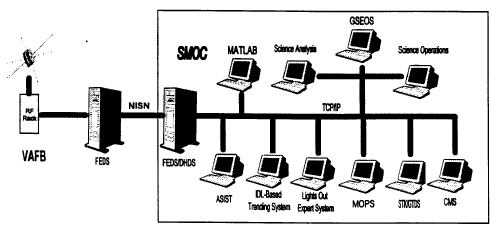
Following spacecraft I&T at LMMS, the IMAGE spacecraft is shipped to WR where final pre-launch testing is performed, as illustrated in Figure 4000-1.
Figure 4000-1: CGS Support for Pre-Launch Testing at Launch Site
After launch, the IMAGE spacecraft will be supported by the DSN during its Deployment, IOC and nominal mission operations. Full operational support of IMAGE by the SMOC through the DSN is shown in Figure 4000-2.
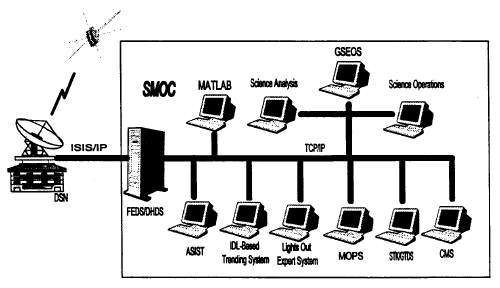
Figure 4000-2: CGS/DSN Mission Operation Support
4100.1		The SMOC shall provide a physically secure SMOC facility
                which provides external interfaces and data security for a scheduling
                system, a command and control capability, a telemetry data processing
                facility, a data management capability to support mission operations, and a
                science operations capability.

Response: Requirement will be met
Table 4000-1: IMAGE SMOC Interfaces
| Source | Dest. | Data | Rate | Freq. | Period | Remarks |
| DSN | SMOC | Composite Telemetry |
2.2857 Mbps | each pass (1/orbit) |
Launch minus 12 mo. to EOM |
34 m, baseline rate |
| DSN | SMOC | Composite Telemetry |
44,000 | each pass | Launch to EOM | 34 m, launch to EOM |
| DSN | SMOC | DSN monitor blocks |
1 packet/ 5 min |
each pass | Launch minus 12 mo. to Launch |
as needed |
| DSN | SMOC | DSN messages |
2.4 kbps | each pass | Launch minus 12 mo. to EOM |
DSN messages contain radio metric and internal station delay data |
| DSN | SMOC | Scheduling Feedback |
N/A | each pass | Launch minus 12 mo. to Launch |
34 m subnet is sched. 6 months in advance |
| LMMS | SMOC | Composite Telemetry |
2,285,700 bps 44,000 bps |
as required | Launch minus 14 mo. to Launch minus 1 month |
I/F with ETU and FU |
| SMOC | NSSDC | Composite Telemetry (IDFS) |
N/A | as required |
Launch minus 12 mo. to EOM |
|
| SMOC | NSSDC | Level-1 CDF products |
N/A | as required |
Launch minus 12 mo. to EOM |
|
| SMOC | LMMS | Commands (S/C) |
2 kbps | as required |
Launch minus 12 mo. to Launch |
|
| SwRI | SMOC | Commands (science) |
N/A | weekly | Launch minus 14 mo. to EOM |
|
| SMOC | DSN | Retransmit request |
N/A | as required |
Launch minus 12 mo. to EOM |
|
| SMOC | DSN | Commands (S/C) |
2 kbps | each pass | Launch minus 12 mo. to EOM |
|
| SMOC | DSN | Scheduling Requests |
N/A | each pass | Launch minus 12 mo. to EOM |
34 m subnet is sched. 6 mo. in advance by JURAP |
| SMOC | DSN | Acquisition and Planning Data |
N/A | as required |
Launch minus 8 mo. to L2 |
|
| SMOC | IMAGE WWW |
Composite Telemetry (IDFS & CDF) |
N/A | as required |
Launch to EOM | |
| SMOC | WR | Commands | 2 kbps | as required |
Launch minus 3 mo. to Launch |
|
| WR | SMOC | Composite Telemetry |
2,285,700 bps 44,000 bps |
as required |
Launch minus 3 mo. to Launch |
|
| FDF | SMOC | Radio Metric Data |
N/A | each pass | Launch minus 12 mo. to EOM |
FDF conditioned data |
| SMOC | DSN | P-files | N/A | each pass | Launch minus 12 mo. to EOM |
Response: Requirements will be met
The following specific items will be delivered:
4111.1 VCDUs.
4111.2 Ground Station Status Monitoring Blocks.
4111.3 Radio Metric Data.
Response: Requirements will be met
4115.1		FEDS shall at a minimum provide the following functions:

                4115.1.1 Capture of data via a serial (RS422) interface, FDDI fiber optic
                interface, or 10baseT interface

                4115.1.2 Capture data via network interface (TCP/IP or FTP)

                4115.1.3 Frame synchronization

                4115.1.4 Pseudo Random Noise decoding

                4115.1.5 Cyclical Redundancy Check (CRC)

                4115.1.6 Reed-Solomon Decoding

                4115.1.7 Virtual Channel sorting

                4115.1.8 Packet reassembly

                4115.1.9 Real-time packet output (TCP/IP)

                4115.1.10 Real-time Virtual Channel Data Unit (VCDU) output (TCP/IP)

                4115.1.11 Telemetry Data Archive

                4115.1.12 Playback archived data based on VC, APID, ground receipt time or
                S/C time

                4115.1.13 Re-package CLTUs into 4800 bit Block wrapper

                4115.1.14 Send 4800 bit Block via packets to ISIS Fanout

                4115.1.15 Connect via socket interface to ISIS Fanout

                4115.1.16 Commanding

                4115.1.17 Level-0 processing by spacecraft time

		4115.1.18 RICE decompression

4115.2		FEDS shall at a minimum provide the following statistics on
                data received:

                4115.2.1 Lock Frame count

                4115.2.2 Flywheel frame count

                4115.2.3 Bit slip frame count

                4115.2.4 Loss of lock counts

                4115.2.5 CRC error count

                4115.2.6 Reed-Solomon correction count

                4115.2.7 Reed-Solomon failure count

                4115.2.8 Counts of VCDUs received by VC

                4115.2.9 Counts of Packets received by APID

                4115.2.10 Counts of Commands blocked and sent

                4115.2.11 ISIS status messages

Response: Requirement will be met
If the IGSEs do not read the telemetry data within 10 minutes of receipt from the Electrical Ground Support Equipment (EGSE) for any reason, the FEDS will not guarantee near-real-time delivery of playback data. The IGSEs must then disconnect from the real-time data stream and acquire the playback data from the DHDS.
The SMOC will provide for the off-line exchange of telemetry data with the instrumenter computer systems. No processing of the data is required other than appending telemetry frame quality information to the data.
The ASIST workstation that is supplied to SwRI shall have the ability to process and display telemetry data. The ASIST shall provide the capability to construct real-time commands and send them to the FEDS to be routed, or sent directly, to the SCU simulator. The format of the telemetry and commands shall be based on the IMAGE IGSE/SGSE Interface Requirements Control Document.
4116.1		The SMOC shall provide real-time and playback telemetry
                packets locally to the Mission Analysis Room (MAR) for each of the
                instrument ground systems, with up to 10 IGSEs.

4116.2		The maximum real-time delay to the IGSEs is specified in
                the IMAGE IGSE/SGSE Interface Control Document.

4116.3		The SMOC shall provide a user telemetry interface to allow
                users to request telemetry packets that are extracted from the playback
                telemetry channel.

4116.4		The user telemetry interface shall allow the user to specify a list
                of VC/APIDs and spacecraft time range of the packets.

4116.5		The data extraction and transmission of playback packets
                shall not interfere with the transfer of real-time packets to another IGSE.

4116.6		The SMOC shall be capable of accepting command packets for
                subsequent uplink from up to 10 users as specified in the IMAGE IGSE/SGSE
                Interface Requirements Control Document.

4116.7		The SMOC shall display the NASA 36-bit time in the MAR for
                instrument users.

Response: Requirements will be met
4118.1		A FEDS will be placed at the data input/output of the S/C
                for TLM/CMD I/F to the SMOC while IMAGE is on the pad or in the VAFB I&T
                facility.

Response: Requirement will be met

4118.2		The DSN CTT will be provided at VAFB for Launch Site RF I/F
                testing, with a hardline I/F to the SMOC.
4119.1		The SMOC and MAR shall be capable of receiving, processing
                and displaying NASA 36-bit time.

4119.2		The capability to correlate S/C time to ground time to
                within 1 second shall be provided.

4119.3		The SMOC and MAR shall have the capability of displaying
                two countdown/countup clocks triggered by the NASA 36-bit clock.

Response: Requirements will be met
4122.1		The SMOC shall provide at least one printer.

4122.2		The SMOC shall provide the capability to print screen dumps
                of displays; log system events; print telemetry snapshots of any display
                page whether or not the specified page is active; and generate plots of
                operator-selected data versus time.

Response: Requirements will be met
The system shall provide the capability to periodically display raw and converted data on displays. The displays may be textual or contain graphics.
4123.1		The user shall be able to select the update rate (maximum 1
                Hz) of any display page.

4123.2		The system shall support the display of up to 500 telemetry
                items at the maximum 1Hz refresh rate.

4123.3		The system shall provide the user with the capability to
                print the contents of any load or dump image.

4123.4		The system shall provide display pages; printouts and log
                files that log all ground system events; limit failures; flight events; and
                all command mnemonics and bit patterns issued by the system

4123.5		The system shall provide page displays showing the contents
                of on-board tables.

Response: Requirements will be met
Author and Curator:
Dr. D.R. Williams, dwilliam@nssdc.gsfc.nasa.gov, +1-301-286-1258